Soil Types Across Czech Regions
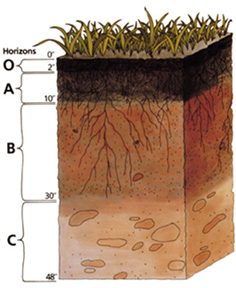
The Czech Republic's geological diversity produces several distinct soil types relevant to gardening. Chernozem (černozem) dominates the South Moravian lowlands — deep, humus-rich, and naturally fertile with pH values between 6.5 and 7.5. These soils support a wide range of crops and ornamentals with minimal amendment.
Brown forest soils (hnědá půda) cover much of the Bohemian uplands and the Vysočina plateau. They are moderately acidic to neutral (pH 5.5–6.8), often with a compact clay-loam subsoil that restricts drainage. The Praha Basin and surrounding areas include significant deposits of alluvial loam — moderately fertile but prone to compaction under foot traffic.
Sandy Podzol soils in the Třeboňská pánev basin and western Bohemia are naturally acidic (pH 4.5–5.5) and low in nutrients. These require different management: organic matter additions rather than lime, and attention to water retention during summer dry spells.
Testing Before Amendment
Soil testing before any amendment programme is the single most effective step a gardener can take. In the Czech Republic, certified soil analysis is available through the Central Institute for Supervising and Testing in Agriculture (Ústřední kontrolní a zkušební ústav zemědělský — ÚKZÚZ) and several accredited private laboratories. A standard panel covering pH, available phosphorus, potassium, magnesium, and humus content costs between 300 and 700 CZK depending on the provider.
Home pH meters and indicator strips give approximate readings useful for monitoring but should not substitute laboratory analysis for initial assessment. Colour-indicator kits calibrated to Czech soil standards are available at most Czech agricultural supply stores (ZZN prodejny).
Correcting pH
Soils above pH 7.5 are uncommon in Czech gardens but do occur near old construction rubble, chalk substrates, or where lime-heavy irrigation water has been used for many years. Reducing pH significantly in established clay-loam soils is slow and requires consistent input of acidifying amendments over several seasons. Elemental sulphur (síra) at 50–100 g/m² applied in autumn and incorporated to 20 cm depth can shift pH by approximately 0.5 units per season on sandy loam. Results on heavy clay are less predictable.
Raising pH on acidic Podzol soils uses ground limestone (mletý vápenec) or dolomitic lime (dolomitický vápenec). Standard rates for Czech Podzol soils run from 150 to 300 g/m² depending on current pH and clay content. Liming is best done in autumn before the freeze cycle, allowing winter moisture to distribute the amendment through the profile.
Organic Matter and Compost
Czech garden soils — particularly the compacting brown loams of central Bohemia — benefit significantly from annual organic matter additions. Well-rotted garden compost applied at 3–5 cm depth and incorporated to the top 15 cm before spring planting improves both drainage in wet periods and moisture retention during summer drought.
Compost quality matters more than quantity. Material that has not fully decomposed (still recognisable plant material, temperatures below 40 °C during the heap process) can introduce pathogen loads and compete for nitrogen during decomposition. Czech gardening literature — including the Zahradkářský svaz ČR guidance — recommends a minimum 6–9 month composting period with regular turning for reliable results.
Drainage in Heavy Soils
Waterlogging after snowmelt (typically February–March) and after heavy convective rain (June–July) is a recurrent issue in gardens on the Bohemian basin clay loams. Root damage from oxygen-deprived soil is a common but underdiagnosed cause of poor plant performance in these areas.
For established beds, surface drainage channels cut at the lowest perimeter point reduce ponding duration. In new beds on heavy clay, incorporating coarse horticultural grit (grain size 3–6 mm) at 15–20% by volume of the top 30 cm meaningfully improves drainage without creating the sharp hydraulic break that can occur with a thin gravel layer beneath loam.
Raised beds constructed to 30–40 cm depth, filled with a structured mix of garden loam, compost, and grit, resolve drainage problems definitively on difficult ground and are increasingly common in Czech domestic and allotment gardens.
Mulching
Mulching has two distinct functions in Czech gardens that are often conflated. In summer, a 5–8 cm organic mulch layer (composted bark, wood chip) suppresses weed growth and reduces soil moisture loss during Moravian dry spells. In winter, the same mulch provides some frost protection to shallow-rooted perennials and bulbs — though on heavy loam, an excessively thick mulch can trap moisture and promote crown rot during freeze-thaw cycling in January and February.
Gravel mulch (2–4 cm of 8–15 mm stone) around the crowns of Mediterranean perennials such as Lavandula, Salvia, and Rosmarinus is the standard practice for improving winter survival on Czech alkaline loam, as it prevents the clay from closing around the plant base during frost expansion.
Reference Sources
Soil classification data referenced in this article follows the system used by the Research Institute for Soil and Water Conservation (VÚMOP). National soil maps and profiles are accessible through their public data portal. Lime application rates follow the ÚKZÚZ published guidelines for Czech soil types (2021 edition).
Soil amendment recommendations in this article reflect typical outcomes on the soil types described. Results in individual gardens depend on local conditions, current organic matter levels, and application timing. Consult an agronomist before large-scale amendment programmes.